
ISO 2009 Slotted Countersunk Flat Head Screws
ISO 2009 slotted countersunk flat head screws, M1.6 to M10 — the metric counterpart of DIN 963 with the full collected 10-size table: head-cone geometry, slot limits and thread lengths with the small-size footnote.
Last updated: 2026-11
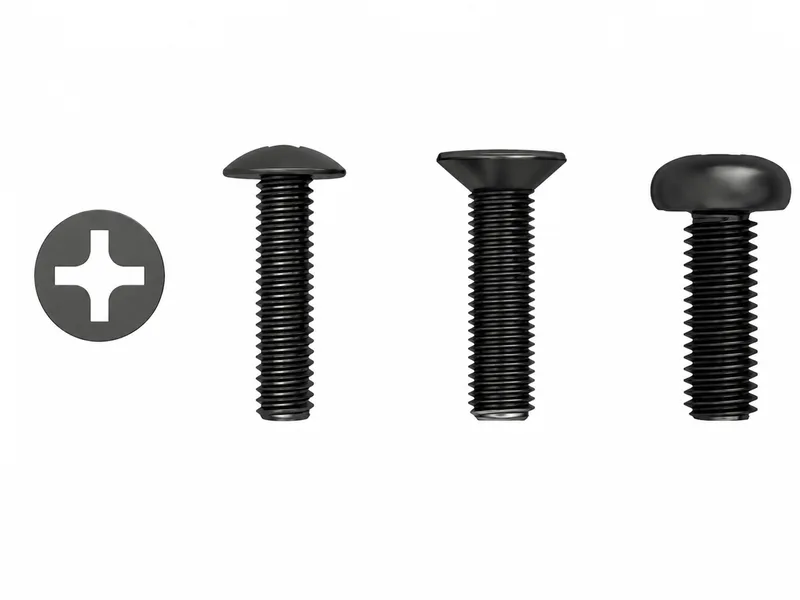
Specifications
ISO 2009 is the slotted countersunk flat head screw: a flat-top head with a 90-degree cone that seats flush in a matching countersink, driven by a simple slot. It is the metric successor designation to DIN 963 — the collected page states the substitution directly — so drawings calling DIN 963 are filled from ISO 2009 stock at the same cone geometry. Flush seating is the whole point of the choice: where a pan or cheese head must stand proud of the surface, the countersunk head disappears into it, which is why this head form dominates assemblies with sliding or contacting surfaces — machine ways, cover plates under moving parts, fitments where nothing may snag. The collected table runs M1.6 to M10 across three block tables and tabulates per size: pitch P, the a runout and x thread-end lash limits, the head system as two distinct diameters — the theoretical d k max that the unbroken cone would reach, and the actual d k with max=nominal / min limits, the circle that seats on the countersink rim — plus head height k, slot width n with Nominal / max / min limits, slot depth t with min/max limits, the r fillet and the thread length b ladder (15 to 40 mm). At the small end the table carries the standard's footnote: minimum lengths only with thread up to near the head. Materials, property classes and finishes are not printed by the collected specification and follow the drawing callout.
| Standard | ISO 2009 — slotted countersunk flat head screws (collected page notes it replaces DIN 963) |
|---|---|
| Series | M1.6 – M10 (10 sizes across three block tables) |
| Tabulated geometry | Per size: pitch P, runout a max, head diameter d k theoretical max and actual (max=nominal / min), head height k max=nominal, slot width n (Nominal / max / min), slot depth t (max / min), fillet r max, thread-end lash x max, thread length b |
| Dimensions at M3 | d k theoretical max 6.3 / actual max=nominal 5.5 / min 5.2; k max=nominal 1.65; n nominal 0.6 (max 0.8 / min 0.66); t max 0.85 / min 0.6; a max 1; x max 1.25; b 19 |
| Dimensions at M6 | d k theoretical max 12.6 / actual max=nominal 11.3 / min 10.87; k max=nominal 3.3; n nominal 1.6 (max 1.91 / min 1.66); t max 1.6 / min 1.2; a max 2; x max 2.5; b 28 |
| Dimensions at M10 | d k theoretical max 20 / actual max=nominal 18.3 / min 17.78; k max=nominal 5; n nominal 2.5 (max 2.81 / min 2.56); t max 2.6 / min 2; a max 3; x max 3.8; b 40 |
| Thread-length footnote | Per the collected table: minimum lengths — footnote 1) only with thread up to near the head |
| Materials / strength | Not tabulated by the collected specification — per RFQ (property class and finish per drawing callout) |
Materials
- Material, property class and finish specified per RFQ — the collected specification table covers geometry only
Ordering & documentation
Documents
Shipments are backed by Mill Test Certificate (MTC), Dimensional Report, Salt Spray Test Report on request, with full batch traceability from raw material to finished product. Quality management follows the owner-confirmed compliance list: ISO 9001:2015, RoHS, REACH. Exact document sets are confirmed on the order.
Quotation
- The fastener family (ISO 2009 Slotted Countersunk Flat Head Screws) plus the standard designation from your drawing — DIN / ISO / JIS / ASTM / ANSI, or a drawing for custom parts.
- Size (diameter and length), thread type (metric or inch), property class or grade, and coating or finish.
- Quantity per size and your target delivery date.
- Destination country, and any required documents (for example a mill test certificate) so the quote includes them.
Sample & supply
Minimum order quantity is 10,000 pieces. Stock items run 3–7 days. Quantities or variants outside the standard range are confirmed at quotation.
Storage & shipping
Parts are packed for export and shipped factory-direct to buyers in Europe, Asia, the Americas and the Middle East. Store fasteners dry and protected until installation, and keep coated parts in their packaging until use; specific packing and preservation requirements can be stated on the order and confirmed at quotation.
Frequently asked questions
The table lists two head diameters — theoretical and actual. Which one sizes my countersink?
The theoretical d k max is where the perfect 90-degree cone would intersect the surface plane — an idealisation used to cut the countersink tool. The actual d k band (for example max=nominal 5.5 / min 5.2 at M3) is the real head rim after manufacture, and it is always smaller than theoretical because the head is truncated where the slot depth and edge limits bite. Practical rule: cut the countersink to the theoretical diameter so the actual head rim lands just below the surface, then verify flushness against the min column — a countersink cut to the actual max instead will leave the theoretical-cone edge standing proud at the tolerance extremes.
How does ISO 2009 relate to DIN 963 and the cross-recessed ISO counterparts?
The collected page prints the mapping directly: ISO 2009 replaces DIN 963 — same slotted countersunk family, so a DIN 963 drawing callout is satisfied by ISO 2009 stock at matching geometry. The geometry in the collected table matches the DIN 963 table on this site size for size, which is what lets the substitution hold without a drawing change. If your assembly is power-driven and you want cam-out resistance instead of a plain slot, the cross-recessed counterpart (ISO 7046-1, H and Z recesses) shares the same head-cone envelope — the decision is drive tooling, not seating geometry.
What is the MOQ and lead time for these screws?
Minimum order quantity is 10,000 pieces per item. Stocked sizes ship in 3–7 days; non-stock diameters, lengths or finishes are quoted with a confirmed schedule. Common sizes in this designation are widely stocked — confirm the exact schedule against quantity and size mix at quotation.
Related knowledge
- Thread-Forming vs Thread-Cutting vs Thread-Rolling Self-Tapping Screws: What the Evidence Settles on Base Material
- Screw Family Selection by Base Material: Wood, Machine and Self-Tapping Threads, Engagement and Coating
- Hex Bolts vs Socket Head Cap Screws: What the Evidence Settles on Strength, Clearance and Cost
Request a Quote
Get factory-direct pricing from the manufacturer.
What to include in your inquiry
- ✓ Standard and property class (e.g. DIN 912, ISO 4762, class 8.8) — or a drawing for custom parts.
- ✓ Sizes, lengths and thread type (metric or inch).
- ✓ Quantity per size and your target delivery date.
- ✓ Destination country, plus any coating or finish requirement.
- ✓ Any documents you need with the shipment (e.g. mill test certificate) so the quote includes them.
- ✓ Your inquiry goes straight to the factory team by email and gets a reply within 24 hours.
- ✓ Factory-direct pricing
- ✓ Standard and custom specifications
- ✓ Factory-direct export to buyers in Europe, Asia, the Americas and the Middle East
- ✓ Full fastener family support