
ISO 14585 Hexalobular Pan Head Tapping Screws
ISO 14585 hexalobular pan head tapping screws ST2,9 to ST6,3 — TORX drive meets the sheet-metal pan head, with the collected d2/k/TORX/(A)/t attribute rows per tapping thread.
Last updated: 2026-11
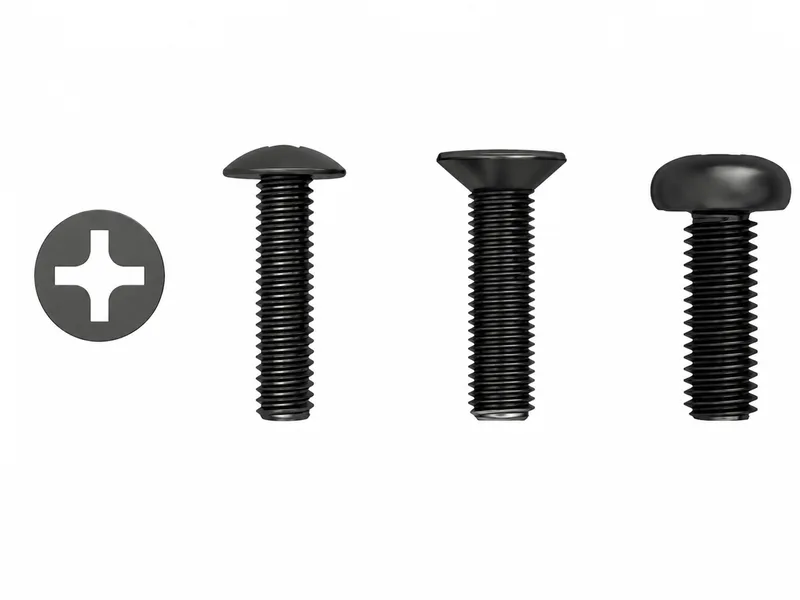
Specifications
ISO 14585 puts the hexalobular socket into the tapping-screw pan head: TORX drive (No. 10 through 30 across the range) on a rounded sheet-metal head, for panel work where power-tool torque and cam-out resistance matter and no countersink prep is wanted. The collected table runs the ST2,9 – ST6,3 tapping series with the compact tapping attribute set: head diameter d2 max. (5,6 → 12 mm), head height k max. (2,4 → 4,6), the TORX drive number, the hexalobular socket nominal size (A) — printed with parentheses by the source and carried with them — and socket depth t max. (1,27 → 2,42). This is the smaller sibling of the x117 machine-thread hexalobular pages: the drive rows line up (TORX 20 at ST4,2 here vs TORX 20 at M4 on the machine pages), so shop tooling transfers between the tapping and machine members. Note the source's own title truncates after "pan head" — the ST thread row is what identifies the tapping series, and the table caption says so. The collected page stops at these attribute rows: no length ladder, no tapping-form y rows — lengths and tapping form are per RFQ, as are material and finish.
| Standard | ISO 14585 — hexalobular pan head tapping screws (ST tapping series) |
|---|---|
| Size range | ST2,9 – ST6,3, six sizes in the collected attribute rows |
| Head geometry | d2 max. 5,6 → 12 mm; k max. 2,4 → 4,6 |
| Drive | TORX 10 → 30; socket size (A) 2,8 → 5,6; socket depth t max. 1,27 → 2,42 |
| Not tabulated | Length ladder, tapping form, material, finish — per RFQ |
| Attribute | ST2,9 | ST3,5 | ST4,2 | ST4,8 | ST5,5 | ST6,3 |
|---|---|---|---|---|---|---|
| d2 max. | 5,6 | 7 | 8 | 9,5 | 11 | 12 |
| k max. | 2,4 | 2,6 | 3,1 | 3,7 | 4 | 4,6 |
| TORX | 10 | 15 | 20 | 25 | 25 | 30 |
| (A) | 2,8 | 3,35 | 3,95 | 4,5 | 4,5 | 5,6 |
| t max. | 1,27 | 1,4 | 1,8 | 2,03 | 2,03 | 2,42 |
Materials
- Material and finish specified per RFQ — case-hardened steel is the standard tapping body; state host sheet and any plated finish at quotation
Ordering & documentation
Documents
Shipments are backed by Mill Test Certificate (MTC), Dimensional Report, Salt Spray Test Report on request, with full batch traceability from raw material to finished product. Quality management follows the owner-confirmed compliance list: ISO 9001:2015, RoHS, REACH. Exact document sets are confirmed on the order.
Quotation
- The fastener family (ISO 14585 Hexalobular Pan Head Tapping Screws) plus the standard designation from your drawing — DIN / ISO / JIS / ASTM / ANSI, or a drawing for custom parts.
- Size (diameter and length), thread type (metric or inch), property class or grade, and coating or finish.
- Quantity per size and your target delivery date.
- Destination country, and any required documents (for example a mill test certificate) so the quote includes them.
Sample & supply
Minimum order quantity is 10,000 pieces. Stock items run 3–7 days. Quantities or variants outside the standard range are confirmed at quotation.
Storage & shipping
Parts are packed for export and shipped factory-direct to buyers in Europe, Asia, the Americas and the Middle East. Store fasteners dry and protected until installation, and keep coated parts in their packaging until use; specific packing and preservation requirements can be stated on the order and confirmed at quotation.
Frequently asked questions
TORX pan tapping (ISO 14585) or the classic slotted pan (ISO 1481) — when does the drive upgrade pay?
Volume and torque. The slotted pan head drives with any flat blade and forgives dirt, but it cams out under power torque — every high-speed panel line replaces it with a recessed drive. The hexalobular socket is the strongest of the recess family: the collected drive rows show TORX No. 15 already at ST3,5 (A 3,35) where the slotted member is still on a 1 mm slot, and torque transfer scales with that engagement. Two honest trade-offs from the collected evidence: first, this page's attribute set is thinner — no slot/t rows because there is no slot, but also no length ladder or tapping-form rows in the capture, so lengths and tapping form are RFQ lines while the slotted page carries its full trade-size matrix. Second, the recess demands the matched TORX driver per the table (No. 10 at ST2,9 through No. 30 at ST6,3) — bit inventory is part of the cost. For maintenance quantities the slotted member stays the forgiving choice; for production runs the hexalobular wins. Material and finish per RFQ on both.
Related knowledge
- Thread-Forming vs Thread-Cutting vs Thread-Rolling Self-Tapping Screws: What the Evidence Settles on Base Material
- Screw Family Selection by Base Material: Wood, Machine and Self-Tapping Threads, Engagement and Coating
- Hex Bolts vs Socket Head Cap Screws: What the Evidence Settles on Strength, Clearance and Cost
Request a Quote
Get factory-direct pricing from the manufacturer.
What to include in your inquiry
- ✓ Standard and property class (e.g. DIN 912, ISO 4762, class 8.8) — or a drawing for custom parts.
- ✓ Sizes, lengths and thread type (metric or inch).
- ✓ Quantity per size and your target delivery date.
- ✓ Destination country, plus any coating or finish requirement.
- ✓ Any documents you need with the shipment (e.g. mill test certificate) so the quote includes them.
- ✓ Your inquiry goes straight to the factory team by email and gets a reply within 24 hours.
- ✓ Factory-direct pricing
- ✓ Standard and custom specifications
- ✓ Factory-direct export to buyers in Europe, Asia, the Americas and the Middle East
- ✓ Full fastener family support